

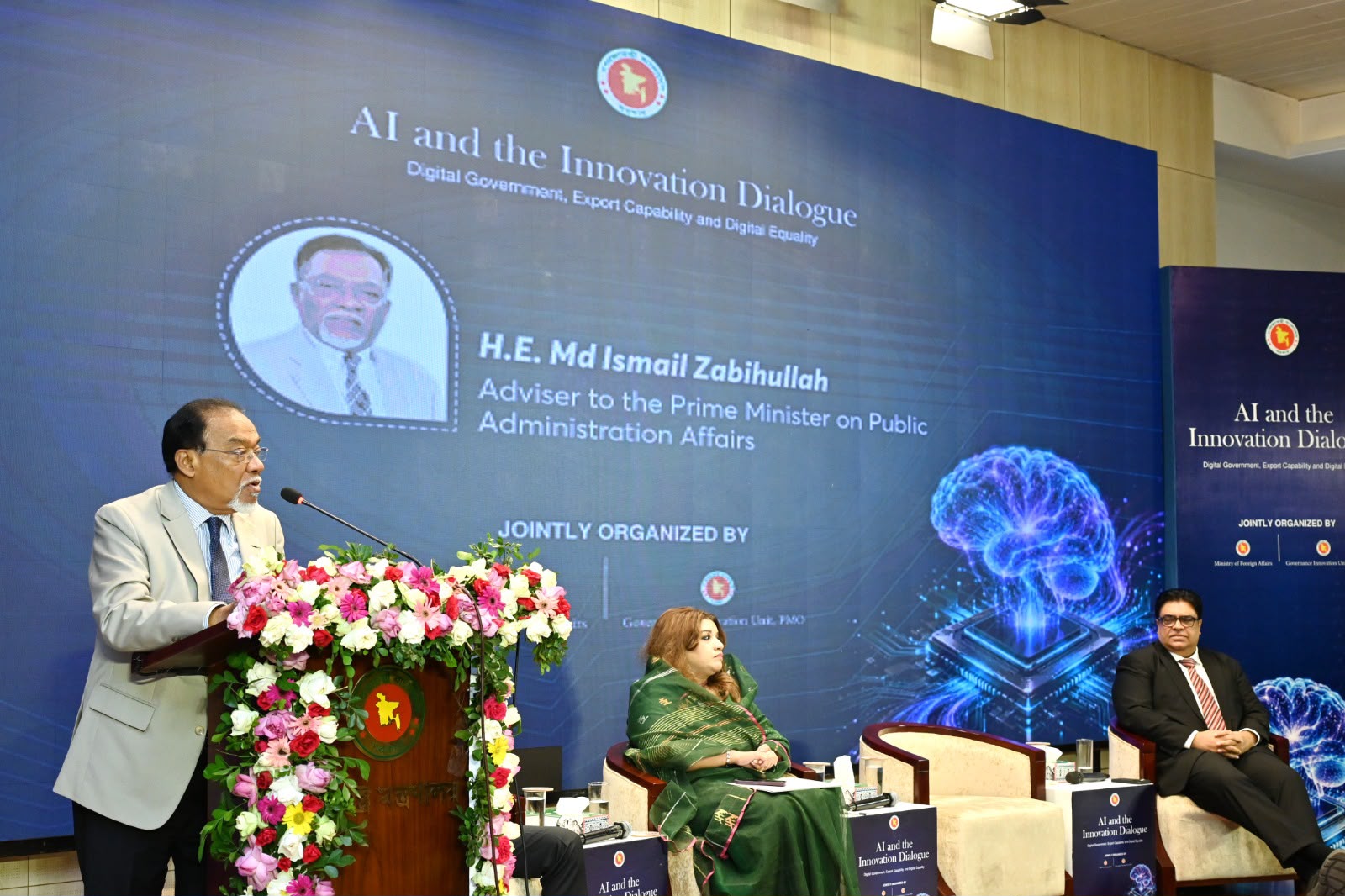

He made the remarks as the chief guest at the “AI and Innovation” dialogue, jointly organised by the Governance Innovation Unit (GIU) of the Prime Minister’s Office and the Ministry of Foreign Affairs on Thursday (October 8) at the Ambassador Ferdous Shahriar Auditorium of the Ministry of Foreign Affairs.

He said Bangladesh exported nearly $44 billion worth of goods in the 2024–25 fiscal year, with around 90 percent of the earnings coming from the readymade garment (RMG) sector. During the same period, the country received approximately $30.3 billion in remittances.

While the RMG sector and remittances remain major pillars of the economy, excessive dependence on a limited number of sources could create risks in the long run, he said. Bangladesh therefore needs to diversify its sources of foreign exchange earnings, particularly by expanding the technology and services sectors.
The adviser emphasised the need to develop artificial intelligence (AI), software, outsourcing and technology-driven services into billion-dollar industries. He said Bangladesh could build a technology-driven industrial base by leveraging its large pool of young and talented people.

Referring to his visit to Silicon Valley, Ismail Zabihullah said technology companies such as Apple, Meta and Nvidia have shown interest in Bangladesh. He also said Anthropic has responded positively to the possibility of working in Bangladesh.

Calling for greater effectiveness of the Ministry of Foreign Affairs’ International Trade and Investment Wing, he said Bangladesh’s commercial wings abroad should strengthen direct engagement with entrepreneurs, investors, technology companies and potential buyers.
He said local companies should be encouraged to develop AI-based solutions for government services, agriculture, healthcare and education. At the same time, Bangladesh needs to strengthen its domestic capacity to manufacture hardware and reduce dependence on imports of technology products such as computers and laptops.
The adviser also called for a practical national action plan on AI to be formulated quickly through coordinated efforts involving universities, the business community and government institutions, rather than limiting discussions on AI to seminars and dialogues.
The event was attended by State Minister for Foreign Affairs-1 Humayun Kabir, State Minister for Foreign Affairs-2 Shama Obaid Islam, Adviser to the Prime Minister Rehan Asif Asad, as well as diplomats from various countries, development partners, academics, government officials, information technology experts, business leaders and representatives of the media.