


A new door of government-to-government (G2G) trade cooperation with Pakistan has opened with the aim of strengthening the supply system of daily necessities, ensuring food security and expanding alternative sources of imports. To this end, a five-year memorandum of understanding (MoU) has been signed between the Trading Corporation of Bangladesh (TCB) and the Trading Corporation of Pakistan (TCP). Under this, the two countries will be able to import and export rice, wheat, sugar, edible oil, pulses and various other daily necessities, agricultural products and agricultural inputs according to their needs.
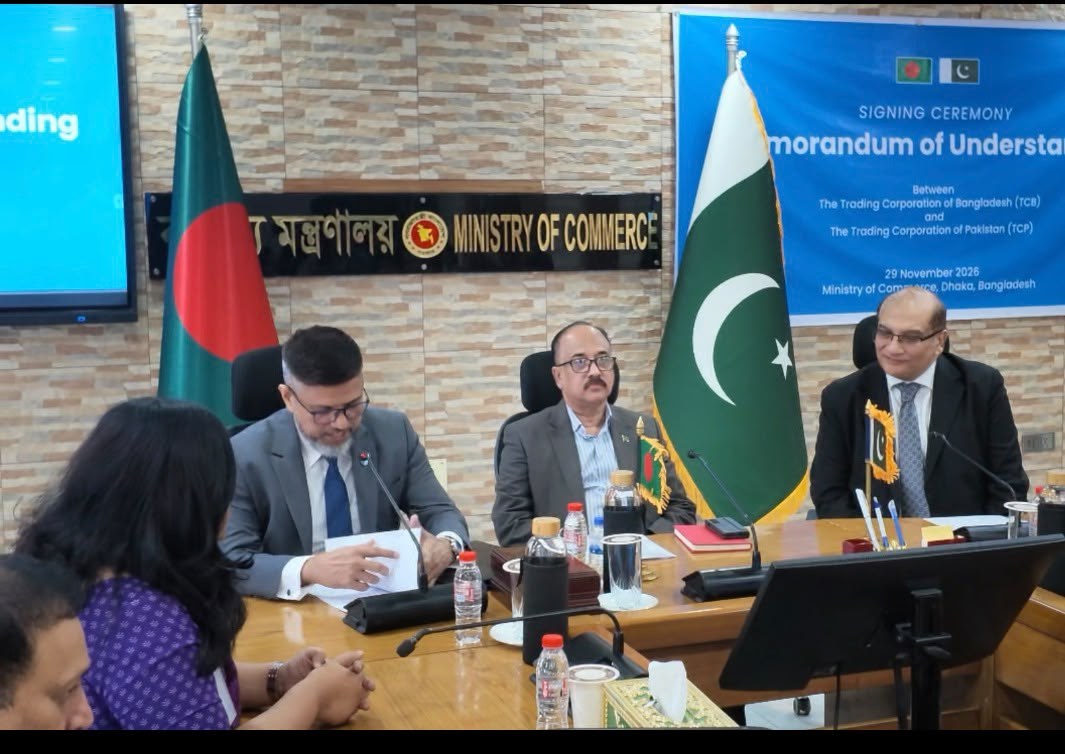
The MoU was signed at an event held in the conference room of the Ministry of Commerce at the Secretariat on Sunday (November 29). TCB Chairman Brigadier General Mohammad Faisal Azad signed on behalf of Bangladesh and Pakistan's High Commissioner to Dhaka Imran Haider signed on behalf of Pakistan. Officials concerned of the governments of Bangladesh and Pakistan, including Commerce Secretary Sharaf Uddin Ahmed Chowdhury, were present at the event.
According to the MoU, the state-owned commercial entities of the two countries will be able to buy and sell various products based on their needs and mutual consent. The list of potential products includes all types of rice, wheat, refined and unrefined sugar, and various types of edible oils, including canola, soybean, sunflower, rice bran and palm olein. In addition, various agricultural products and agricultural inputs, including sesame, potato, onion, lentil, chickpea, tea, pineapple, jackfruit, dates and fertilizer, will also be under this trade cooperation.
However, signing the MoU does not mean a final agreement to immediately import or export these products. If either party wants to procure a specific product, it will have to give a written proposal to the other party mentioning the product's quality, quantity, specification and possible supply time. Later, separate product-wise agreements will be finalized through discussions and bargaining to determine the supply conditions. As a result, although an institutional framework for direct government trade between the two countries has been created, the price, quantity, quality and supply schedule of each transaction will be finalized separately.

At the event, Commerce Secretary Sharaf Uddin Ahmed Chowdhury said that through this MoU, direct and well-organized commercial relations will be established between the state-owned commercial entities of Bangladesh and Pakistan. This will create new opportunities for mutual cooperation in the import and export of daily necessities and agricultural products, while safeguarding the economic interests of both countries. He also said that the relevant organizations will be able to finalize the terms of transactions by directly discussing product quality, quantity, supply schedule and financial matters.

The commerce secretary emphasized regular communication between TCB and TCP, timely evaluation of commercial proposals, and overall cooperation of the commerce ministries of the two countries for effective implementation of the agreement. He said this initiative will play an important role in expanding trade and economic cooperation between the two countries.
Pakistan's High Commissioner Imran Haider said that through this MoU, a direct institutional relationship will be created between the state-owned commercial entities of the two countries, which will help make the import-export and supply system of daily necessities more organized. He noted that Pakistan has surplus stocks of various agricultural products, including basmati rice, onion, potato and spices. Pakistan is ready to supply these products according to Bangladesh's demand.
Highlighting progress in bilateral relations, the high commissioner further said that cooperation in various fields, including trade, education and communication, has increased in recent times. Pakistan has withdrawn anti-dumping duties on hydrogen peroxide imported from Bangladesh. It has also maintained a duty-free quota for the import of 10,000 metric tons of tea from Bangladesh per year. He also mentioned that the first consignment of Bangladeshi pineapples reached Karachi from Dhaka last October.
On the other hand, TCB Chairman Brigadier General Mohammad Faisal Azad said that this MoU will not remain limited to a formal document or an expression of mutual goodwill; rather, transforming its core objective into tangible commercial outcomes will be the joint responsibility of the two institutions. According to him, it will serve as an important institutional platform for exploring opportunities for mutually beneficial trade, facilitating the product procurement process and increasing cooperation between the two institutions.
He further said that TCB and TCP will work closely to identify specific products, set competitive prices, ensure quality, and supply products on time according to the needs of both countries. He expressed hope that this will further smoothen the path of expanding mutual trust and result-oriented trade between the two countries.
The MoU will remain in effect for five years from the date of signing. If neither party takes steps to cancel it, it will be automatically renewed for another five years. However, either party may cancel it by giving at least three months' written notice through diplomatic channels.
According to those concerned, if there is a food supply crisis in the international market, price increases, or uncertainty in conventional import sources, the opportunity to procure products from alternative sources can become important for the country. In particular, since there is a framework for direct trade at the government level, new possibilities will be created in product procurement and supply. However, how much positive impact this MoU will have on the country's market for essential commodities will depend on product-wise agreements, import costs, competitive prices, product quality and ensuring timely supply.
This five-year MoU between TCB and TCP is being considered an important initiative for expanding trade relations between Bangladesh and Pakistan, as well as for creating alternative sources in the country's food security and supply system for daily necessities.