

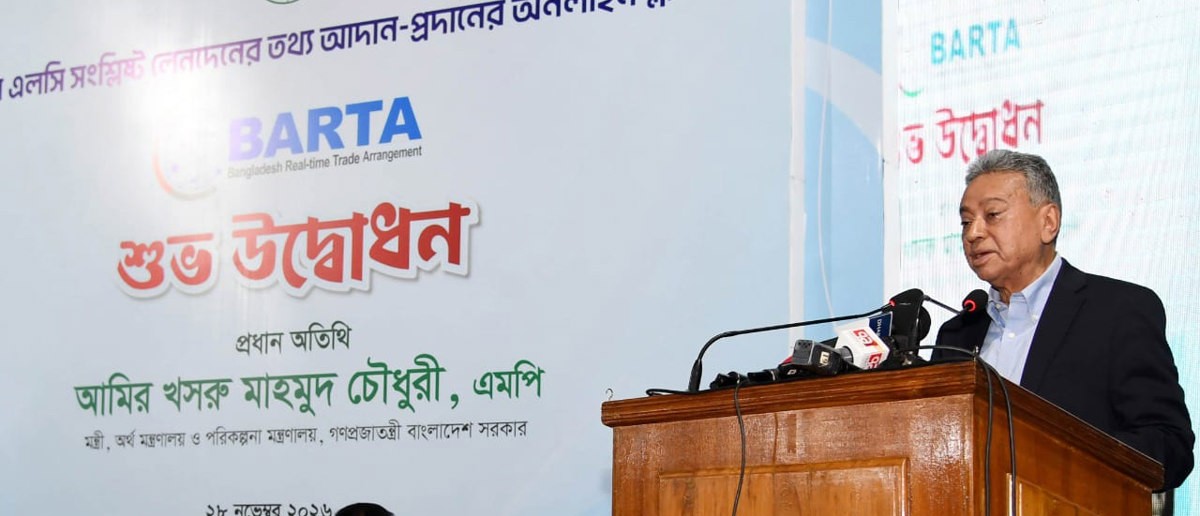

He said global trade and investment are now conducted in real time. Bangladesh's economy must also keep pace with that speed. If the information systems of various ministries and financial institutions remain isolated, it will not be possible to reduce the cost of doing business and ensure transparency. There must be interconnection among the central bank, the capital market and other financial institutions.

Citing irregularities in the insurance sector, Amir Khosru said that in many cases cover notes were issued without payment of insurance premiums. There have even been cases of cover notes being taken without paying premiums for imports of goods worth Tk 1,000 crore. As a result, the government lost revenue, insurance company shareholders were harmed and the parties concerned faced various problems.

He said interconnection is being created among Bangladesh Bank, the LC-related banks and insurance companies to stop such irregularities. Transparency will also be ensured in back-to-back LCs in the same way. Initiatives have been taken to connect the capital market regulator BSEC, the Dhaka and Chittagong stock exchanges, listed companies and brokerage houses to the same digital system.
The Finance Minister said automation not only increases efficiency, it also reduces business costs and ensures transparency. In many cases the government is being deprived of revenue because of secret transactions and irregularities. It will be possible to stop these irregularities through the digital system.

Stressing the importance of taking stakeholders' opinions in reform activities, he said discussions must be held with all concerned parties before implementing any reform. If stakeholders do not come forward, no reform, however proactive, can be implemented.

At the event, officials concerned of Bangladesh Bank presented the activities and benefits of the 'Barta' platform. They said that until now, SWIFT (Society for Worldwide Interbank Financial Telecommunication) was used to exchange information on local and international LCs. As a result, information on local LCs also first went abroad to SWIFT's network, and from there reached the concerned bank. The bank then sent the information to the supplier.
Under that system, an average of about Tk 1,500 was spent for each LC, which had to be paid in foreign currency. Besides, there was no opportunity to store all the information centrally within the country. If any old information was needed, it had to be collected by applying separately to SWIFT.
On the new 'Barta' platform, information will be exchanged over the own networks of commercial banks and Bangladesh Bank. There will be no need to send information through any foreign institution. Every LC's information will be stored centrally and can be collected instantly from Bangladesh Bank when needed.
According to central bank data, a total of 579,110 local LCs were opened in the country in the 2025-26 fiscal year. At Tk 1,500 per LC, the total cost stands at Tk 86.86 crore. The equivalent foreign currency expenditure was USD 724,000. Excluding commercial banks' income, the net foreign currency expenditure stands at about USD 615,000.
Under the new system, no messaging fee will have to be paid for local LCs. As a result, this money will be saved.
On the 'Barta' platform, when a bank opens an LC, the concerned supplier's bank will know about it instantly. If any amendment to the LC is needed, that too can be done quickly. This will reduce the time for opening, amending and confirming LCs and exchanging related documents.
Besides, since all LC information will be stored centrally, the relevant documents can be obtained quickly if any dispute or dispute settlement is needed. Earlier, foreign systems had to be relied upon to collect such information.
Central bank officials said that on the new platform, information on every LC can be monitored from opening to settlement. Earlier, if commercial banks did not provide information, not all information reached the central bank's monitoring system instantly. Now, since information is exchanged directly under the central bank's supervision, any expired or overdue LC can be identified quickly.
This will increase coordination between exporters and local suppliers. The domestic industry's backward linkage will be strengthened and local value addition in exports is expected to increase.
Central bank officials said the 'Barta' platform will have encrypted VPN, firewall, token-based verification for each API call and a two-tier login system for users for security. Three steps - maker, checker and authoriser - must be followed for approving each transaction.
Each responsible person will have a separate power-on password and a system access password. As a result, a total of six password security layers will work in approving a message. This is expected to reduce the risk of unauthorised access and misuse of information.
At the event, FBCCI Administrator Md Fazlul Haque said that bigger than the saving of USD 615,000 a year is that Bangladesh is gaining the confidence of building its own technological capability. The value of this initiative of being able to build the systems it needs by itself is much greater.
He said if such a system can be introduced for international LCs in the future, it will be easier to monitor the prices and transactions of import-export goods. This may also make the work of the Bangladesh Financial Intelligence Unit (BFIU) easier.
BGMEA President Mahmud Hasan Khan said the charge of Tk 1,500 for each local LC was a significant cost for the garment industry. Because after receiving export orders, garment factories have to open many small-value local LCs. Even if the amount of some LCs is 700, 1,000 or 1,500 dollars, the number of LCs is very large.
He said that under the new system, along with reduced costs, transparency in transactions will increase and dispute settlement will become easier. However, banks' LC opening and acceptance charges are still a major business cost. Especially small and medium entrepreneurs cannot bargain with banks. A Bangladesh Bank guideline is needed to keep these charges at a tolerable level for them.
Bangladesh Bank Governor Mostakur Rahman said reducing the cost of doing business is one of the central bank's top priorities. Its benefits are not limited to businessmen or bankers; ultimately ordinary people benefit by getting goods and services at lower prices.
He said various initiatives have been taken to reduce businessmen's financial costs. If inflation comes under control, there may be scope to reduce the policy interest rate further. Besides, a Tk 7,000 crore SDP has been launched for businessmen, through which interest subsidies are being provided.
The Governor also said work is underway to introduce an automatic and transparent auction system for determining the foreign currency exchange rate. This will ensure market-based exchange rate determination and reduce the scope for manipulation. The system is expected to be launched within one to two months.
Besides, initiatives have been taken to digitise the documents of international LCs to reduce courier costs and time in sending them. The central bank hopes this will make it possible to bring down document sending time to within one to two days.
Finally, the Governor called upon businessmen and bankers to use the new 'Barta' platform.
The chief guest at the event was Finance and Planning Minister Amir Khosru Mahmud Chowdhury. Bangladesh Bank Governor Mostakur Rahman presided. Deputy Governor Habibur Rahman, FBCCI Administrator Md Fazlul Haque, BGMEA President Mahmud Hasan Khan, top officials of various banks and businessmen were present at the time.