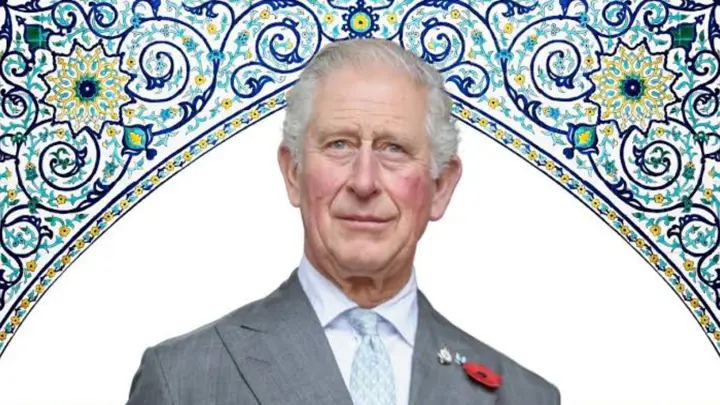

From his 1993 Oxford lecture titled 'Islam and the West', to 'Unity in Faith' at Egypt's Al-Azhar University in 2006, 'Islam and the Environment' in 2010, and his Ramadan messages on various occasions — together, they reveal a consistent line of thought on Islam and Muslim society.

The distinctive feature of Charles's remarks is that he did not consider Islam merely as the faith of a religious community. Rather, he recognised Islam's contribution to the knowledge, spirituality and cultural development of human civilisation. At the same time, he criticised mutual misunderstanding between Muslim and Western societies, historical hostility, materialism and religious extremism.

In his lecture on 27 October 1993 at the Sheldonian Theatre, organised by the Oxford Centre for Islamic Studies, he said misunderstanding between the Islamic and Western worlds had reached a dangerous level. There is not enough awareness in the West of how indebted Western civilisation is to the Islamic world. In the Middle Ages, Muslim scholars contributed to laying the foundation for the later European intellectual awakening by preserving, translating and interpreting Greek and Roman philosophy, science and classical knowledge. He said Islam is part of Europe's past and present.
In that lecture, he also said Islam does not create an artificial division between man and nature, religion and science, mind and matter; it has preserved a view of the universe as an integrated reality. In his view, Western society's judgment of Islam has often been influenced by a few extremist examples; extremism is not a monopoly of Islam, nor of Christianity or any other religion.

In his 1996 Wilton Park lecture, 'A Sense of the Sacred', he said that in Islamic tradition, nature is not merely an object for human consumption; nature has its own dignity, and it is man's duty to protect its balance.

After the 2005 London terrorist attacks, he opposed blaming Muslims collectively and wrote in the Daily Mirror that the cause of the problem is not Islam; it is a distortion of traditional Islam. In his understanding, Islam teaches humanity, tolerance and social harmony.
In his 2006 'Unity in Faith' lecture at Al-Azhar University, he highlighted the shared heritage of Islam, Christianity and Judaism and the need for mutual respect, and quoted verse 13 of Surah Al-Hujurat of the Holy Quran. In the same lecture, speaking on the controversy over cartoons of the Prophet Muhammad (PBUH), he said the failure to understand and respect what is sacred and valuable to other people can have terrible consequences.
In his 2010 lecture, 'Islam and the Environment', he said the root cause of the current environmental crisis is not only technological limitations; man's consumerist mentality and the weakening moral basis of his relationship with nature are also causes. Islam contains moral guidance on protecting nature's balance, abstaining from waste, and behaving responsibly towards creation.
In his Ramadan message during the Covid pandemic in 2020, he praised the contributions of Muslim volunteers, doctors, nurses and health workers, and highlighted Ramadan's lessons of charity and selfless service.
Even after becoming king in 2022, this position of his received importance in international media. During his Kenya visit in 2023, he visited the Mandhry Mosque in Mombasa and met leaders of various religious communities. On 17 July 2025, at the 40th anniversary programme of the Oxford Centre for Islamic Studies, he said understanding the Muslim world is more important now than at any time before.
All in all, Charles's remarks on Islam should not be seen merely as courteous comments; they are a sustained effort at Western civilisation's self-criticism, recognition of Islamic civilisation's historical contribution, and using religious knowledge to address the modern world's moral and environmental crises.